
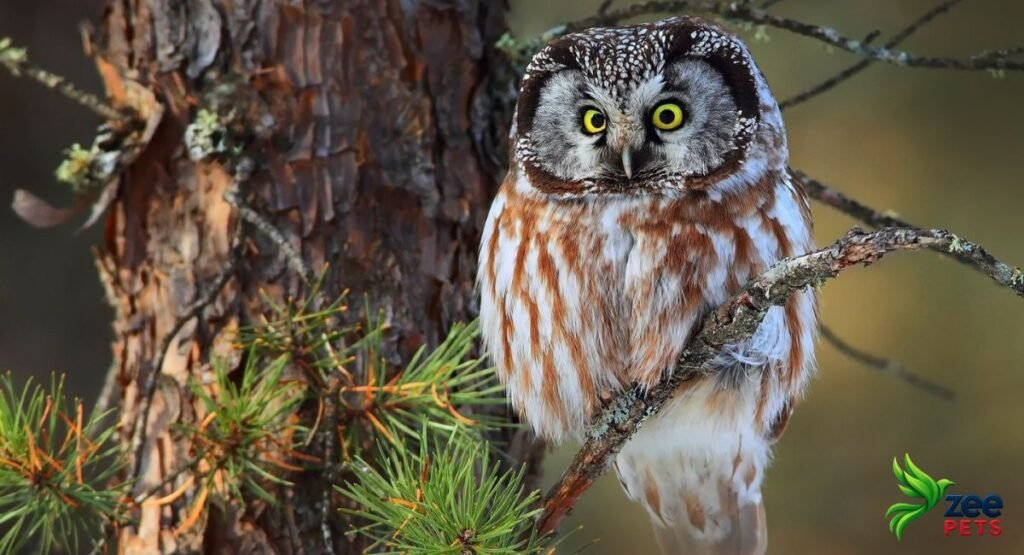

On a calm night, when the world feels still and almost motionless, an owl can glide just inches above the ground without making the faintest sound. Most predators announce themselves long before they strike — a rustle, a flap, a snap of a branch. But owls are different. They move with a softness so complete that many animals never sense them coming until it’s too late. This quiet mastery has earned owls the title of the silent hunters of the night sky, and the more you learn about them, the more impressive their skills become.
Feathers Designed for Soundless Flight
The secret behind an owl’s silent approach lies mostly in its feathers. While many birds have smooth, stiff flight feathers that generate a clear flapping sound, owls have a completely different design. Their wings are covered with soft, velvety feathers that muffle noise. Along the front edge of each wing is a row of tiny serrations that break up the air as they fly, reducing turbulence — the main source of sound during flight.
This allows owls to glide slowly and quietly, even at low altitudes. Their wings are also unusually large compared to their body size. Bigger wings mean less flapping, and less flapping means less noise. Put all these features together, and you get an animal that seems to float through the night like a drifting shadow.
Eyes Built for Darkness
An owl’s eyes are another part of its night-hunting power. Unlike most birds, owls have forward-facing eyes that give them excellent depth perception — the kind humans rely on to judge distance. Their enormous eyes gather every bit of available light, allowing them to see clearly even when the moon is hidden and the world seems pitch-black to us.
But their eyes don’t move inside their sockets. If you watch an owl, you’ll notice that instead of shifting their eyes, they turn their entire head. And they can turn it far — up to 270 degrees. This ability helps them track prey with incredible accuracy, scanning the ground from high branches or while gliding through the dark.
Hearing So Sharp It Seems Unreal
If their eyes weren’t enough, owls also have some of the best hearing in the animal kingdom. Many species have asymmetrical ears — one placed slightly higher than the other. This uneven design allows them to locate sound from multiple directions, pinpointing exactly where a small mouse or rustling insect is hiding.
Even the shape of their face plays a role. The round facial disk works like a satellite dish, funneling sound directly into their ears. A tiny scratch under the leaves or the movement of a small mammal is enough for an owl to lock onto its target, even if it can’t be seen.
Talons Built for a Swift, Powerful Strike
Once an owl locks onto prey, the next moment is quick and decisive. Their talons are strong, curved, and incredibly sharp, designed to grab tightly with surprising force. Some species can grip with a strength similar to larger birds of prey, despite being much lighter in weight. They don’t waste time or energy — a clean, silent swoop, one swift grab, and the hunt is complete.
Their legs are also feathered, helping muffle any noise the wind might make as they descend. Everything about the owl’s body is engineered for a perfect, quiet attack.
Masters of Patience and Precision
Owls aren’t reckless hunters. They rely on patience and observation. Most species perch quietly and watch for movement, blending into tree branches so well that they’re nearly invisible. Their mottled feathers match bark and shadows, giving them perfect camouflage.
When they spot a target, they don’t rush immediately. They wait for the right moment — a moment when the prey is distracted, unaware, or stepping into the open. Then they make their move. This blend of patience and precision gives owls a high success rate compared to many night predators.
Life in the Nighttime World
While many animals wind down after sunset, owls come alive. Nighttime offers them the perfect environment to dominate. Fewer predators are active, their prey are often tired or less alert, and the still air helps their silent flight work even better.
Their night vision, sensitive hearing, and stealth give them an advantage over almost every small creature that moves after dark. Mice, voles, insects, frogs, and even other birds become part of their nighttime menu. Each species of owl has its own preferred hunting style and prey, from the tiny elf owl that catches insects to the great horned owl that can take down animals larger than itself.
Nature’s Quietest Predators
What makes owls so remarkable isn’t just their beauty or their mysterious presence — it’s the way their entire body works together to create one of nature’s most effective hunting systems. Their wings silence the air, their eyes brighten the dark, their ears catch the faintest movements, and their talons finish the hunt with precision.
They are silent, focused, and incredibly adapted to the world of night. While many animals rely on speed or brute strength, owls succeed through stealth and skill, proving that sometimes the quietest hunters are the most powerful of all.